

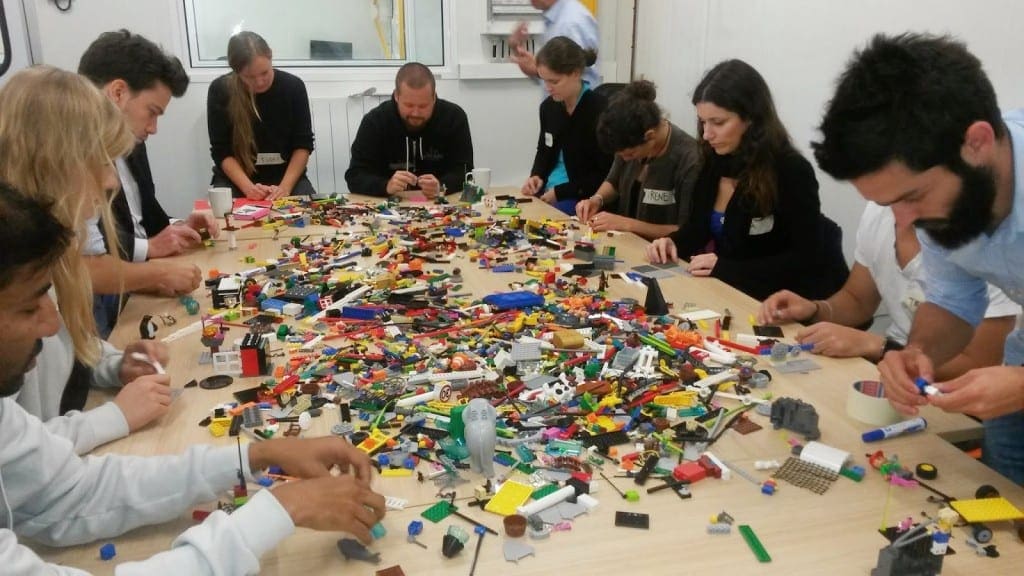
- The 5 Building Blocks: A Digital Transformation Framework That Actually Works
- The Pattern Behind the Building Blocks: Why Each One Matters
- Operational Excellence: The Foundation That Makes AI Transformation Possible
- Customer Intelligence: Why B2B Companies Can’t Use the Data They Already Have
- Product Intelligence: Why Your Smart Products Are Failing (And What Actually Works)
- Data Mastery: The Information Flow Problem Behind Every AI Initiative
- Team Dynamics: Why Your Biggest AI Challenge Isn’t Technical
The real AI skills gap isn't about finding data scientists. It's about bridging the gap between people who hoard knowledge and people who need it, between employees protecting their value and organizations that need teams to work differently.
The most experienced person on your operations team refuses to document how they run month-end close. The sales manager who knows every customer relationship inside-out won’t train anyone else. The engineer who understands your most complex products keeps everything in their head. Your best data analyst builds brilliant spreadsheets that only they can maintain.
These aren’t malicious people. They’re protecting themselves the only way they know how. Their specialized knowledge is their job security. In a world where companies automate processes and eliminate positions, being the only person who knows how something works feels like insurance against obsolescence.
But this knowledge hoarding is killing your ability to transform. You can implement the most sophisticated AI platforms, deploy cutting-edge analytics tools, and invest millions in digital infrastructure. None of it matters if the people who hold critical knowledge won’t share it, the people who need to change their workflows won’t adopt new approaches, and teams can’t collaborate across the traditional boundaries that AI requires.
The skills gap everyone talks about isn’t really about finding data scientists. It’s about bridging the gap between people who hoard knowledge and people who need it. Between employees who resist change because they’re protecting their value and organizations that need teams to work differently. Between individuals focused on their own jobs and the cross-functional collaboration that AI demands.
Here’s the uncomfortable truth: the age and experience of your workforce matters more than anyone wants to acknowledge. Not because older workers can’t learn technology – that’s nonsense. But because the risk calculation is different when you’re 28 versus 58. When you’re early in your career, learning new skills expands opportunity. When you’re late in your career, you’ve seen enough reorganizations and layoffs to know that “training” sometimes precedes “replacement.”
Team Dynamics is the fifth of the building blocks for your digital transformation. It’s the one that makes all the others actually work. You can have operational excellence, customer connection, Product Intelligence, and Data Mastery – but if your teams can’t collaborate, won’t share knowledge, and resist changing how they work, those capabilities sit unused. Team Dynamics isn’t optional. It’s the foundation that determines whether everything else creates value or just creates complexity.
The Knowledge Fortress
A mid-sized manufacturer ran month-end financial close in four business days. For a company their size, that was respectable. The process was complex – consolidating data from multiple plants, reconciling inventory across locations, applying cost allocations, generating management reports. But it worked smoothly, month after month.
The process worked because Susan knew how to run it. She’d been the senior financial analyst for twelve years. She knew which reports to pull from the ERP, which manual adjustments to make, where the data quality issues lived, and how to work around them. She knew which numbers needed extra scrutiny and which managers would have questions about their results. Month-end close ran through Susan.
The CFO wanted to reduce close time to three days and automate more of the process. This made business sense – faster close meant earlier results, better ability to course-correct during the month. The company brought in consultants to document the close process and identify automation opportunities.
The consultants spent weeks shadowing Susan, trying to understand exactly what she did. She showed them the reports she pulled, the spreadsheets she maintained, the reconciliations she performed. But when they asked her to explain why she made certain adjustments or how she knew which exceptions to investigate, the answers got vague. “I just know from experience.” “It depends on the situation.” “I can tell when something doesn’t look right.”
This wasn’t Susan being difficult. Trying to articulate tacit knowledge – the kind developed through years of practice – is genuinely hard. How do you explain intuition? How do you document pattern recognition that happens unconsciously?
But there was also resistance. The consultants wanted to standardize the process, document the rules, build automated checks. All of that would make the process less dependent on Susan specifically. She’d spent twelve years becoming indispensable. Now the company wanted to make her knowledge transferable, which felt uncomfortably close to making her replaceable.
The automation project stalled. Without Susan’s full cooperation in documenting her expertise, the consultants couldn’t build reliable automation. The company couldn’t force her to share knowledge – they needed her to keep the current process running. Susan retained her critical role. Month-end close still took four days.
This pattern plays out constantly in organizations trying to transform. The people who hold critical knowledge recognize that knowledge is their leverage. Making that knowledge explicit and transferable reduces their leverage. Even when companies offer incentives for knowledge sharing, the calculation doesn’t always make sense from the employee’s perspective.
The Skills Gap Nobody Talks About
When executives discuss the skills gap for AI and analytics, they usually mean technical skills. We need data scientists. We need machine learning engineers. We need people who understand Python and neural networks and cloud architectures.
But hiring technical specialists doesn’t solve the real skills gap. The real gap is between how people work today and how they need to work for AI to create value.
A global industrial company invested heavily in analytics training. They sent dozens of employees to certification programs in data science, analytics tools, and visualization platforms. They built a state-of-the-art analytics environment with access to comprehensive data from across the business. They brought in vendor experts to train teams on the new tools.
Six months after the training program ended, usage of the analytics platform was minimal. A few people used it regularly – mostly the same ones who’d been doing analytics work before. The majority of trained employees had gone back to their old workflows. Spreadsheets. Manual reports. The same processes they’d always used.
The company did exit surveys with the trained employees. Why weren’t they using these powerful new tools? The answers revealed the real problem. The tools were technically excellent, but they required fundamental changes in how people worked:
“The analytics platform shows me insights, but I still need to put numbers in the format my boss expects, so I end up recreating everything in Excel anyway.”
“To build the analysis I need, I have to collaborate with people in other departments who have the data I need. It’s easier to just work with what I have access to.”
“The automated reports don’t answer the specific questions my customers ask. I need flexibility to customize, which means building it myself.”
“Learning the platform was interesting, but using it takes more time than my current approach. I can’t afford to slow down.”
These aren’t excuses. They’re descriptions of organizational reality. The analytics tools solved a technical problem – how to access and analyze data. They didn’t solve the organizational problems – how decisions get made, how departments collaborate, what outputs stakeholders expect, and how performance gets measured.
Technical training without organizational change creates frustrated employees who learned skills they can’t actually apply in their daily work.
The Generational Divide That Matters
The workforce demographics are shifting in ways that matter for AI adoption. For the first time, Millennials are the largest generation in the workforce. Gen Z is entering in growing numbers. Baby Boomers are retiring. These shifts matter, but not for the reasons usually discussed.
The conventional narrative says younger workers are “digital natives” who naturally embrace technology while older workers resist it. That’s overly simplistic and often wrong. Plenty of 55-year-olds are technically proficient. Plenty of 25-year-olds struggle with complex systems.
The real generational divide is about risk calculation and career horizon.
Consider a 28-year-old financial analyst when the company announces an AI initiative to automate financial reporting. This analyst has 30+ years of career ahead. Learning AI tools and analytics platforms opens doors. Becoming skilled at working with AI-generated insights makes them more valuable in a changing job market. Even if their current role becomes automated, those skills transfer to other opportunities.
Now consider a 58-year-old financial analyst in the same situation. They have perhaps 7-10 years until retirement. They’ve mastered the current systems and processes. They’re productive and respected. Learning entirely new tools and workflows feels risky – what if they can’t master the new approach as quickly as younger colleagues? What if the company uses automation as justification for headcount reduction? Why invest years building new skills when retirement is approaching?
Both perspectives are rational given their circumstances. The younger analyst sees opportunity in change. The older analyst sees risk. Neither is wrong.
This creates predictable patterns in who adopts new AI-enabled processes quickly and who resists. It’s not about technical capability. It’s about whether change expands opportunity or threatens security.
The companies that handle this well acknowledge the different risk calculations. They make clear commitments about how AI will change roles (augmentation versus replacement). They provide genuine transition support, not just training. They create paths where experienced employees can contribute their domain expertise to guide AI implementation rather than being displaced by it.
The companies that handle it poorly treat resistance as a training problem and are surprised when technical training doesn’t change behavior.
The Collaboration Challenge
AI requires breaking down organizational silos in ways that traditional technology didn’t. The customer profitability analysis from the previous article demonstrates this perfectly. You need sales data, service costs, logistics expenses, quality metrics, and engineering time – data that lives in different systems owned by different departments.
Getting that data integrated technically is one challenge. Getting the departments to collaborate effectively is harder.
A manufacturer tried to implement predictive maintenance using AI. The technical components were straightforward – sensors on equipment, data pipeline to the cloud, machine learning models to predict failures. But execution required collaboration across groups that traditionally worked independently.
Operations needed to install sensors and collect data. IT needed to build data infrastructure and integrate systems. Engineering needed to define what “normal” versus “abnormal” operation looked like. Maintenance needed to change how they scheduled work based on AI predictions. Finance needed to track whether predicted savings materialized.
Each department had its own priorities, metrics, and incentives. Operations cared about uptime and production output. IT cared about security and system reliability. Engineering cared about product quality. Maintenance cared about workforce utilization. Finance cared about cost reduction.
When the AI model predicted a component failure three weeks out and recommended preventive maintenance, whose priority won? Operations wanted to keep running until the scheduled shutdown. Maintenance wanted to act immediately while they had the parts and people available. Engineering wanted to investigate why the failure was predicted. Finance wanted to quantify the cost of different responses.
Without clear decision rights and collaboration processes, the predictive maintenance initiative generated lots of predictions and very little action. The technical AI implementation worked. The organizational implementation failed.
Successful AI requires cross-functional teams with authority to make decisions that affect multiple departments. It requires shared metrics that reflect collective outcomes rather than departmental goals. It requires people who can translate between different functional perspectives and build genuine consensus rather than compromise.
These aren’t technical skills. They’re organizational capabilities that most companies haven’t systematically developed because traditional systems didn’t require them.
Building Teams That Can Actually Transform
When companies ask how to close the skills gap for AI, they want to talk about hiring and training. Both matter. But neither addresses the root challenge – people working in ways that AI can’t augment because critical knowledge stays trapped in heads, organizational structures prevent collaboration, and individuals rationally resist changes that feel threatening.
Here’s how to assess whether your team dynamics will enable or block AI initiatives:
Can you identify where critical knowledge lives and whether it’s transferable? Not just documented in systems, but whether the people who hold expertise are willing and able to share it. If your answer involves specific individuals who “just know” how things work, you have knowledge concentration risk that will limit AI’s impact.
Do people have room to experiment and learn without jeopardizing their performance? If everyone is running at 100% utilization with no slack for trying new approaches, AI tools will sit unused regardless of how good they are. Learning requires time and safety to fail.
Can teams make decisions that cross departmental boundaries? AI-enabled insights often point to actions that span traditional org chart boxes. If your decision-making processes can’t handle that, insights won’t convert to action.
Are people’s incentives aligned with adopting new approaches? If individuals or departments are measured on metrics that conflict with AI-enabled changes, they’ll rationally resist regardless of training. You can’t expect people to act against their incentives.
Does your culture distinguish between augmentation and replacement? If AI is positioned as automation that eliminates jobs, you’ll get resistance. If it’s positioned as capability that changes jobs, you might get adoption – but only if people believe it.
The companies succeeding with AI aren’t the ones with the most PhDs in machine learning. They’re the ones that built cultures where knowledge flows freely, where people can experiment without fear, where collaboration across functions happens naturally, and where change creates opportunity rather than risk.
The Foundation That Makes Everything Work
You can build perfect operational systems, create seamless customer connections, instrument products with sensors, and integrate data across the enterprise. But if your teams can’t or won’t work differently, none of it transforms the business.
The team dynamics component isn’t the most glamorous part of digital transformation. It’s not about cutting-edge technology or innovative products. It’s about organizational change, knowledge management, collaboration processes, and culture. It’s hard, slow work that doesn’t photograph well for quarterly earnings presentations.
It’s also the foundation that determines whether the other four building blocks actually create value or just create complexity.
AI amplifies whatever team dynamics you’ve built. Strong collaboration patterns get stronger. Knowledge sharing cultures become more powerful. But knowledge hoarding becomes more damaging when AI should be learning from collective experience but can’t access it. Departmental silos become more problematic when AI insights require cross-functional action that organizational structures prevent.
Your transformation doesn’t start with algorithms and cloud platforms. It starts with honest assessment of whether your people can work the way AI requires – sharing knowledge, collaborating across boundaries, adapting to new workflows, learning continuously.
The technical skills gap is real. But the organizational skills gap – the ability to work as connected teams rather than independent specialists – is what actually limits most companies’ AI potential. The good news is you can address organizational gaps without hiring unicorn data scientists. You need executives willing to change incentive structures, managers who create space for learning, and cultural norms that reward collaboration over knowledge hoarding.
When those elements are in place, curious learners with domain expertise become more valuable than technical specialists without business context. The skills you need are already in your organization. The question is whether your organizational dynamics let people apply them effectively.
If you’re wrestling with the people side of AI transformation, I’d love to hear what’s working and what’s not. Join my mailing list for weekly insights on digital transformation that actually works.
2 February, 2026


Comments (0)