

When someone asks my opinion on their writing, I’ll get fairly detailed; I’ve noted in the past that there is a lot of power and influence in the written word, and it’s fairly important to get it done well, or your project proposals just never seem to get off the ground.
This particular proposal suffered from a lack of direction; it didn’t take the reader (the decision maker) through a clear progression. Admittedly, the subject matter was a bit technical and mildly complex; even though this was a proposal for internal IT eyes, the prose didn’t flow, and did not help the reader understand what we are asking for, and why.
I suggested that the subject matter – highly technical services – shouldn’t impact the difficulty we were having in getting the basic idea across. A good way to validate the structure and effectiveness of a written proposal might be to show it to your high school or college-age children. The document should make a cogent argument that a reasonably intelligent person should be able to understand; it doesn’t matter if they understand the technical specifics!
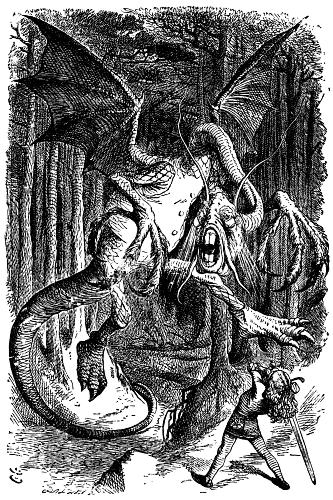
I saw Alice in Wonderland a few weekends ago, and noted that the plot takes a lot from Jabberwocky. Now, I’m not a “Carroll scholar” by any means; I recognized it, was even able to recite most of the lines – but I blame my high school English curriculum. It was [way] back in my sophomore year – we spent a week or so deconstructing the poem, and the teacher pointed out that you don’t need to understand exactly what a jabberwocky is, or what a vorpal blade looks or sounds like – you can identify these foreign-sounding words and concepts (a Jabberwocky is a noun, vorpal is an adjective, and snicker-snak is an alliterative, sounds-like description) in context. You understand the story and the drama in the poem without completely understanding the specifics in the dialog, because it is a well constructed story.
The same goes for this technical proposal. This should be an effective writing piece made to educate; a business proposal, arguing for action or caution, must make an effective argument. The document’s structure has much to do with the success or failure of the proposal – technical details are for a secondary, deep-dive pass, but the basic business argument should be apparent.
Historically, we have seen X
Recently, Y has changed, to Z effect (X is worse than before)
If we take action Q, we can get back to X.
Q will cost J dollars, and bring K benefit within L months
Currently, we are at The As-Is.
Future state will be The To-Be.
We can get there from here if we execute The Action Plan,
at a cost of A dollars and B people’s time over C months.
External Event Alpha requires us to be at future state Beta
We have two alternatives:
– Plan 9, which will cost 10x and require 1 dedicated Framistat – and be delivered in a year
– Plan 10, which will cost 100x and require 5 dedicated Framistats – and be delivered in a month
Due to Factor Gamma, we recommend Plan 10
As a good common sense check for your writing effectiveness – run it past someone outside your team, someone with solid business sense but not necessarily a deep grasp of the details. There are many patterns for laying out persuasive arguments; learn them, before someone takes a vorpal blade to your next project plan.



Comments (0)