

- Creating AI Value: What’s In It For You?
- Creating AI Value for Shareholders
- Creating AI Value for Employees
- Creating AI Value for Customers
- Connecting AI Initiatives to KPIs
By the third vendor demo of the week, every pitch promised to transform the customer experience, and nobody had said what the customer actually needs. Customer Obsession is AI's real sweet spot, but only if you work outside-in. A leader's lens for evaluating AI customer initiatives, focused on creating AI value for customers.
By the third demo, the slides had started to blur together. Same gradient backgrounds, same confident voiceover, same promise to revolutionize the customer experience. This one had a chatbot that could “understand emotion.” The one before lunch had sentiment dashboards in nine colors. Two more were on the calendar for tomorrow.
Somewhere in the second hour, a product manager leaned over and asked the only question that mattered. “Which one of these actually helps our customers?” Nobody had a good answer. The vendors had spent all morning answering a different question – which tool was the most powerful, the most integrated, the most AI. Not one of them had started with the customer.
That’s the trap with AI value for customers. The tools are genuinely impressive, the pitches are relentless, and you can burn a whole quarter evaluating platforms without once asking what your customers actually need from you. The vendor’s roadmap quietly becomes your roadmap. The conversation drifts from “what would delight the person who buys from us” to “which subscription tier do we want.”
So let’s step back. Before you evaluate a single tool, the better question is the one the product manager asked, just aimed in the right direction. What value are we creating for our customers? And how would we know we’re creating it from the outside-in, instead of the inside-out?
Great Stock, Great Company, and the Customer
If you’ve been following this series, you know the tension by now. Every company is, in some mix, trying to be a Great Stock and a Great Company at the same time. The first article laid out the productive friction between them. Great Stock is the world the CFO lives in, the world of total shareholder return, capital efficiency, and the multiple the market is willing to pay. Great Company is the other half, the place that makes a product worth buying and stays a decent place to work while doing it.
Great Company has two faces. One is the employees, the people who do the work and build and service what you sell. We spent the last article there, on what AI does to the work itself and whether your people come out more capable or more frustrated. The other face is the customer. That’s where we’re headed now.
And here’s what makes the customer a little different from the rest. A business can limp along for a while without happy employees. It can limp along for a while with an unloved stock. It cannot exist at all without customers. If you’re selling and nobody’s buying, you don’t have a business, you have a hobby with overhead.
So when AI shows up promising to transform the customer relationship, the stakes are higher and the noise is louder. Better to get the thinking right before the spending starts.
Customer Satisfaction Is Not Customer Obsession
Customer service is foundational stuff. Businesses have been thinking about how they serve their customers since the first transaction, and the smart ones built real instruments to manage it, things like Net Promoter Score, on-time delivery, and customer scorecards. Useful tools, every one of them. But notice what they have in common. They all measure how the customer perceives us. How are we doing? How do they rate us? Did we hit the number?
That’s Customer Satisfaction, and it’s a quietly inside-out way to think. The customer is the judge, fair enough, but the company is still the subject of every sentence. The orientation is “how do we look from where they sit,” which is a reactive posture dressed up as a customer-focused one.
There’s a different orientation, and Satya Nadella gave it a name when he rewrote Microsoft’s mission around being customer obsessed. The phrase that stuck with me wasn’t “obsessed,” it was “beginner’s mind,” the idea that you walk into every customer conversation ready to learn something, instead of waiting to slot their problem into the solution you already sell. Pair that with the rest of his framing, the insatiable pull to learn from the outside and the commitment to surprise and delight, and you’ve got something genuinely different from a satisfaction survey.
Here’s the distinction in plain terms. Customer Satisfaction asks whether you delivered what the customer asked for. Customer Obsession asks what the customer actually needs, and then what else is possible that they haven’t thought to ask for yet. One keeps you in business. The other is how you become the company nobody wants to switch away from.
It has held up remarkably well. And it reads even better in the AI era, because for the first time the tools can almost keep up with the ambition.
AI’s Actual Sweet Spot
Here’s what most of the vendor noise misses. AI’s real strengths line up almost perfectly with what Customer Obsession asks for, and that isn’t a coincidence anyone planned. It just happens that “learn from the outside, with a beginner’s mind, at a scale a human can’t match” is a pretty good description of what these tools are actually good at.
Take Voice of the Customer. For decades, listening to customers meant sampling. A survey here, a handful of interviews there, the loudest complaint in the room standing in for the thousand quiet ones. You couldn’t read every support ticket, every review, every recorded call, so you read a slice and hoped it was representative. AI reads all of it. Sentiment analysis across the entire support queue, theme detection that surfaces the problem three hundred customers mentioned in passing but nobody had flagged as a pattern. That’s listening at a scale that was simply out of reach before. The beginner’s mind, finally, with enough ears to use it.
Or transaction efficiency, the unglamorous business of being easy to buy from. Predictive replenishment that notices a customer’s reorder rhythm and offers the thing before they run short. Ordering flows that anticipate instead of just process. None of it is flashy, but friction is what quietly erodes a relationship over time, and finding friction is something AI happens to be good at.
Then there’s the product itself. We’ve had connected products for years now, sensors throwing readings at a dashboard somebody glances at on Mondays. The shift is that the sensor data now feeds AI inference, so the product can reason about what it’s seeing. A machine that doesn’t just report a vibration but predicts the bearing failure two weeks out. That’s the line between a product that’s merely connected and one that’s genuinely smart.
Bain made this point well in a recent piece, “AI Won’t Just Cut Costs, It Will Reinvent the Customer Experience.” Their argument is that the real value isn’t automating the process you already run, it’s redesigning the journey around what the customer is actually trying to accomplish. A bank shouldn’t frame it as mortgage origination, they say, but as helping someone buy a first home with confidence. A retailer shouldn’t think order fulfillment, but getting the product to the customer when and how they need it. Say those out loud and you can hear Satya’s framing underneath, not what the customer asked for, but what they actually need.
Which is the whole point. AI is the first set of tools powerful enough to act on Customer Obsession instead of just nodding along with it.
The Two Ways You Create Customer Value
So how do you put Customer Obsession to work without just buying whatever’s being demoed this week? It helps to have a simple map. At the highest level, the value you create for a customer shows up in two places: in how you connect with them, and in what you actually sell them.
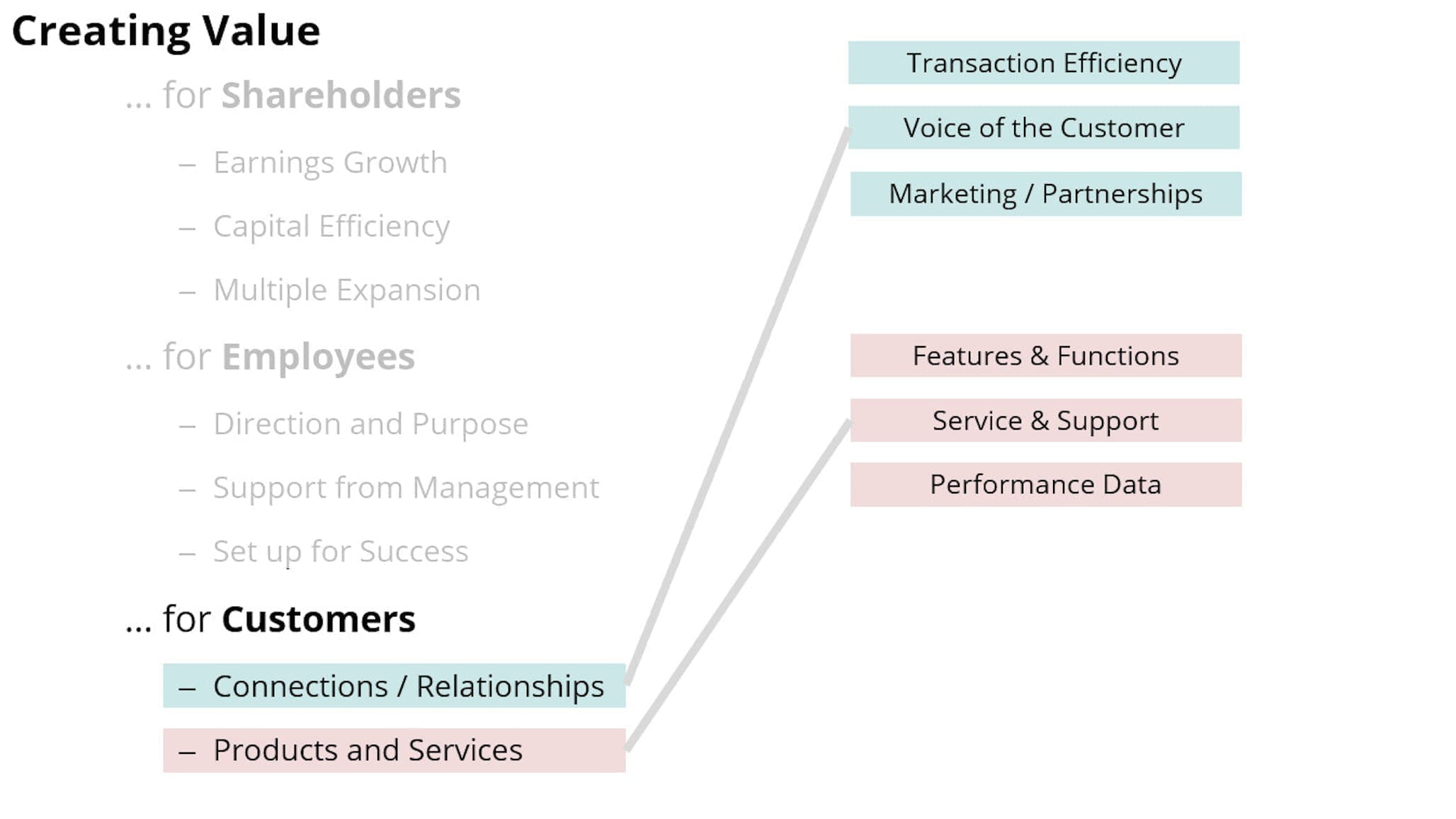
The first is Connections and Relationships, which is how you do what you do and how the customer experiences every part of dealing with you. The question underneath it is whether you understand the whole relationship, from the first time someone goes looking for a solution to the hundredth reorder, and whether you’ve taken the friction out of all of it. Three levers live here. Transaction Efficiency is being easy to do business with, which we just watched AI quietly transform. Voice of the Customer is the active listening, and it’s the lever AI changes most. Marketing and Partnerships is the long game, educating customers on what your product can really do and building relationships around lifetime value instead of the next purchase order. AI earns its keep here too, in the unglamorous job of figuring out which customers deserve your limited relationship-building time.
The second is Products and Services, your actual value-add, the reason anyone pays you in the first place. Three levers again. Features and Functions is applying your design and engineering to solve problems customers can’t solve themselves, and AI inference built into the product is the newest tool in that kit. Service and Support is taking friction out of the help process and letting the product evolve based on how people actually use it, not how you imagined they would. Performance Data is the connective tissue, the operational and transaction data that tells you what to fix, what to build next, and how to make a customer’s life easier before they think to ask.
None of these six levers are new. This is the same map I’ve used for years. What’s new is that every lever on it finally has an AI assist that’s real rather than aspirational. The map didn’t change. The tools that act on it just caught up.
And that’s exactly where it goes wrong for a lot of companies. They let the tool pick the lever. A vendor sells them a chatbot, so Service and Support quietly becomes the whole customer strategy. Start with the map instead. Decide where value actually lives for your customers, then go find the tool. Not the other way around.
When AI Makes the Customer Experience Worse
Now the part the vendor demos skip. AI aimed at customers can absolutely create value. It can also, just as easily, create negative value, and that failure mode is sneaky because it looks like progress on the dashboard.
We’ve all been on the receiving end of this. You call a company with a problem that doesn’t fit the script, and a cheerful bot keeps offering you the three things you already tried, in slightly different words, refusing to let you reach a human who could actually help. The deflection rate looks fantastic in the quarterly review. From where you sit as the customer, the company just told you your problem wasn’t worth a person’s time. That’s not a better experience. It’s a worse one, delivered more efficiently.
The same trap shows up in recommendations that miss. A model that confidently suggests the thing you’d never buy, again and again, teaches the customer that the company doesn’t really understand them. And then there’s personalization that slides from helpful into unsettling, the email that knows a little too much, the “we noticed you were looking at this” that feels less like service and more like being followed. Each of these is technically a customer-facing AI win. Each one quietly subtracts from the relationship.
Here’s the uncomfortable part. Every one of these failures comes from the inside-out posture we started with. The bot that won’t escalate is tuned for our cost, not the customer’s problem. The recommendation that misses is trained on what we want to sell, not what they’re trying to do. The creepy personalization is us showing off what we know, not serving what they need. The tool didn’t fail. The orientation did.
So there’s a simple test worth running before you ship anything customer-facing. Sit on the other side of it. Would this feel like the company gets me, or like the company is processing me? Customer Obsession has a built-in tell. It always lands as the company paying closer attention. If your shiny new feature makes the customer feel watched, managed, or deflected instead, you’ve automated the wrong thing, and you’ll see it in the churn numbers a quarter or two later.
Done well, AI is the best Customer Obsession tool we’ve ever had. Done from the inside-out, it’s just a faster way to annoy the people who pay your bills.
AI Opportunities, by Building Block
Customer value doesn’t sit in one place on the org chart. It runs through the whole business, which is why the customer shows up across all five Building Blocks, not just the one with “customer” in the name. Here’s one AI opportunity in each, aimed squarely at the people who buy from you.
– Operational Excellence: Wire AI into the demand signal. The old version was an EDI connection that automated reordering off stock levels. The new version reads the patterns, the seasonality, and the customer’s own usage data, then gets the right product to them before the shortage instead of after the complaint.
– Customer Connection: Give every customer-facing employee the whole relationship at a glance. AI can summarize years of history, support tickets, and buying patterns into a two-sentence brief before a call, so the customer doesn’t have to re-explain who they are for the fifth time. Nothing says “we don’t really know you” like being treated as a stranger by a company you’ve paid for a decade.
– Product Intelligence: Let the product learn from how it’s actually used. Sensors plus AI inference turn a product that reports its status into one that anticipates trouble, suggests a better setting, or quietly tells you which feature nobody touches and which one they can’t live without. That last part is a product roadmap, handed to you for free.
– Data Mastery: Publish your product data in a form the customer’s own systems can use. Specs, availability, lead times, performance benchmarks, structured so they drop straight into the customer’s workflow and their own AI tools instead of getting trapped in a PDF. Being easy to integrate with is a competitive advantage now, not a nice-to-have.
– Team Dynamics: This one needs no AI at all, and it might still be the best idea on the list. Send your production-line and back-office people on customer visits. The folks who never see the customer build a different kind of empathy once they watch someone actually use the thing they make, often in a way nobody at the plant intended. AI can scale listening. It can’t scale that.
Five blocks, five angles, and you’ll notice the through-line. Every one of them is about understanding the customer better, which is the only thing Customer Obsession ever asked for.
The Customer Is Still King
Strip away the demos and the dashboards and the subscription tiers, and you land back where every business starts. You might have a great market position, a differentiating product, terrific people. Those are real assets. But if you want a business that scales and lasts, the customer is and always will be king. That hasn’t changed in the AI era. If anything it’s more true now, because customers have AI of their own, and they’ll use it to find the company that actually understands them and quietly route around the one that doesn’t.
AI gives you the best shot anyone’s ever had at real Customer Obsession, the listening at scale, the anticipating, the products that learn. It also gives you the best shot anyone’s ever had at automating your indifference and shipping it faster. The tool is the same either way. The orientation is everything.
Which sets up the question the next article has to answer. We’ve now looked at value for shareholders, for employees, and for customers, three lenses that don’t always agree with each other. How does a leadership team hold all three at once and actually decide what to build? That’s where this goes next.
For more like this in your inbox, subscribe to the JazzAI mailing list.
Related Articles
- Beyond the Bot: Building Empathetic Customer Experiences with Agentic AI – McKinsey on why the bots that win are the ones built to understand, not just deflect, which is the difference between Customer Obsession and a cheaper queue.
- Next Best Experience: How AI Can Power Every Customer Interaction – McKinsey on anticipating what a customer needs before they ask, and the line where helpful personalization tips over into feeling spammed.
- Customer Success at a Crossroads: Evolve with AI or Fade Away – Bain on why most customer-success teams are layering AI onto old processes instead of rethinking the work around the customer.
Recommended Books
- Don’t Think So Much – Jim MacLennan on making AI and digital transformation practical, without overthinking it.
- Hit Refresh – Satya Nadella on the growth mindset and customer-obsessed culture that this article’s framing comes from.
- Working Backwards – Colin Bryar and Bill Carr on Amazon’s habit of starting with the customer and working back to the product, Customer Obsession as an operating model.
19 June, 2026




Comments (0)