

- Creating AI Value: What’s In It For You?
- Creating AI Value for Shareholders
- Creating AI Value for Employees
- Creating AI Value for Customers
- Connecting AI Initiatives to KPIs
The dashboard said 17% adoption, and the Teams channel had gone quiet. The board wanted productivity. Nobody asked the people who'd actually use the tool whether they had what they needed. Why AI value for employees isn't the soft question, and how to run a rollout that lands.
The dashboard said 17% adoption. The Teams channel that was supposed to drive engagement had three messages all week. The marketing director was reading the most recent one and trying to figure out what he was going to say to the CEO.
A senior analyst, careful with her words, had written that the new workflow took longer than the old one and produced results she ended up editing heavily. Her message had two replies – one from IT asking what kind of training would help, the other from a teammate quietly agreeing.
The board had approved the tool on the strength of a productivity case that assumed enthusiastic adoption. The vendor demo had been spectacular, the implementation team had checked every box, the change-management plan had been textbook. And the people the tool was actually for, the ones whose jobs were supposed to get better, had decided it wasn’t worth the friction.
This is the question we haven’t answered yet. When an AI initiative gets justified in terms of value created – for shareholders, for the company, for the strategy – someone has to ask what value lands for the people who actually use it. They might be more capable, more engaged, more set up to do good work. Or they might be quietly losing trust in leadership while pretending the tool is fine.
Why AI Value for Employees Isn’t the Soft Question
The temptation, when AI lands, is to treat the employees question as the soft one. The numbers people care about live elsewhere. Productivity is a hard metric, the cynical version goes, and engagement is the thing HR worries about. Some boards are running a version of this calculation right now: cut the headcount that AI makes redundant, take the productivity win, treat engagement as the residual.
The data doesn’t support that calculation. Bain’s “Want More Out of Your AI Investments? Think People First” research found that companies leading AI adoption with a human-centric approach delivered more than two times the TSR of companies that didn’t. The investment was the same, the time horizon was the same, the outcome wasn’t even close. Joel Trammell, in Your Board Is Wrong About AI, points to a Gartner 2026 finding that boards have mostly chosen to ignore: roughly 80% of large enterprises have cut staff tied to AI initiatives, and the correlation between those cuts and improved ROI is essentially zero. Two findings, pulling in the same direction. The boards taking the easy productivity win aren’t, in fact, getting the better return.
AI value for employees, then, isn’t a soft alternative to AI value for shareholders. It’s a driver of it. The companies that figure out how to make AI work for their people are the same ones whose stock charts will look better in five years. Which means the employees question isn’t just a question for HR. It’s a question for whoever’s signing the AI budget.
Engagement, Three Honest Questions
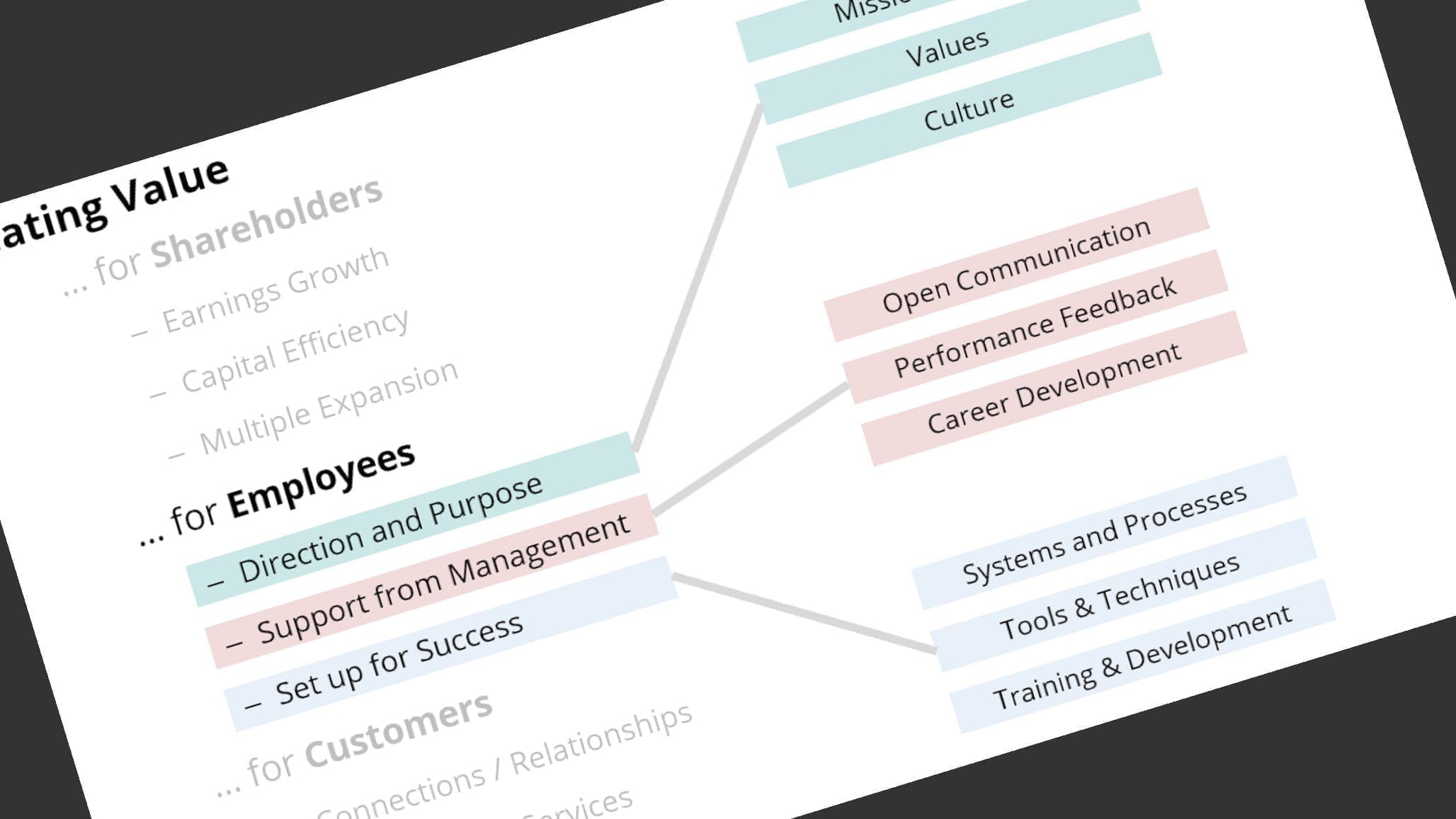
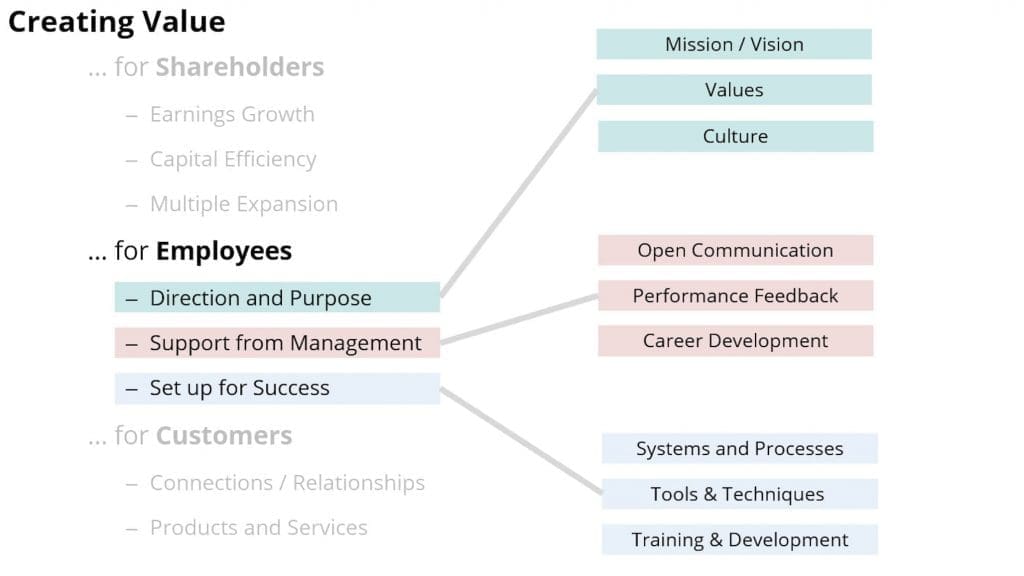
Engagement isn’t a single thing. The conversation gets stuck because people use the word to mean different things, and the measurement gets weird because nobody’s defined what they’re actually measuring. The cleanest honest frame, the one I keep coming back to, breaks engagement into three questions that any team member would recognize if you asked them straight. Do I know where we’re going? Do I get the support I need from my manager? Do I have the tools I need?
The first question is about Direction and Purpose. It sounds high-level, but it lives at ground level for the person being asked. Do I understand and believe in the mission and vision of this company – the reason it exists, the problems it solves, who it serves? Do I know what we stand for in how we operate, the values that are supposed to guide decisions even when nobody’s watching? Do I recognize the culture, the norms of behavior that hold the team together, and do I feel like I belong in it? Three sub-questions, all asking variations of the same thing: do I have a reason to bring my best self to work tomorrow morning?
The second question is about Support from Management. Direct managers, not the leadership team three levels up. Is the communication coming from my manager honest and frequent enough that I know what’s actually going on? Am I getting regular, useful feedback on my performance – both the parts that are working and the parts that aren’t – or am I left guessing? Is anyone helping me think about where I’m going, what I want to learn next, where my career might develop? The team member who can’t answer yes to those three doesn’t have a management problem, they have a management vacancy.
The third question is about being Set Up for Success. This is the most operational of the three, and the easiest to fix if you take it seriously. Do I have the right systems and processes for the work, or am I fighting the way the company has decided things should run? Do I have the tools – hardware, software, equipment – that let me do my job well, or am I making do with what was good enough five years ago? Do I get the training and development I need, both for the work I do now and the work I’m being asked to grow into? This is the dimension that AI initiatives stress-test the hardest, and where most of them fall over.
AI Changes the Work, Not Just the Speed
I’ve worked through enough technology waves to recognize a pattern. Each new wave promises to make work better, and each one has – but in a specific way. ERP made the same work faster and more consistent. The Internet made it reachable from anywhere. IoT made it measurable in real time. The work itself, though, stayed recognizable. The accounts payable clerk still processed invoices. The salesperson still talked to customers. The line operator still ran the machine. The systems around them changed, often dramatically, but the actual job was still the job.
AI is the first wave I can remember where the work itself changes. A marketing analyst doesn’t write copy from scratch anymore – they prompt, edit, direct, and curate output from a model. A coder doesn’t type every line; they describe what they want and refine what the model produces. A customer service rep doesn’t craft every response. The skills that used to define the role – careful writing, deep technical knowledge, patient listening – aren’t gone, but they’re not the daily work. The daily work is something closer to direction, judgment, and quality control.
This is a bigger change than the productivity number suggests. The productivity case captures speed, but it misses substance. The work has different rhythms now, and even the sense of accomplishment shifts. The skills that earned someone their current job aren’t the same skills that will make them good at the new shape of that job. And the employee who used to be the best at writing the polished memo isn’t automatically going to be the best at directing the AI that drafts it.
This lands on all three engagement dimensions at once. Direction and Purpose gets tested because the team needs a clearer story now: why is the work changing, what’s the role of the human still, where is this all heading? The vague “we’re using AI for productivity” answer doesn’t cut it – people can tell the difference between a strategy and a slogan. Support from Management gets tested because direct managers are often learning the new work alongside their teams. The “I’ve been doing this for twenty years, let me show you” pattern of mentorship doesn’t quite work when nobody’s been doing it for twenty years. And Set Up for Success gets tested hardest, because tools and training are now moving targets – the model that was state-of-the-art when the pilot started has already been replaced, the workflow that worked in pilot doesn’t quite work at scale, the training from kickoff is already partially obsolete.
None of this is fatal, and none of it is a reason not to do AI. But it does mean the engagement conversation can’t be a formality. The work is changing under everyone, and the leader who pretends otherwise loses trust faster than they realize.
The Easy Button Problem
A pattern shows up in conversation after conversation with leaders who’ve rolled out AI tools and watched adoption stall. The team comes in expecting an easy button. They’ve seen the demos. They’ve read the productivity claims. They’ve heard their CEO talk about how this changes everything. The implicit promise, never quite stated but everywhere in the air, is that AI will do the work that used to be hard. So they sit down, type in a request, and wait for the magic.
What they get is a partial answer, in the wrong tone, with two facts that need to be verified and one paragraph that needs to be rewritten. The model doesn’t know the company’s voice. It doesn’t know which numbers come from the audited financials and which come from the operations dashboard nobody trusts. It doesn’t know the political dynamics of the executive team who’ll read the memo. It produces a draft that’s faster than starting from scratch, but only if you know how to direct it and what to keep.
The team that came in expecting an easy button decides, fairly quickly, that this thing isn’t worth the trouble. They go back to doing the work the old way. They tell their teammates not to bother. The adoption dashboard flatlines. The board asks why the productivity numbers haven’t moved. And the leader who championed the rollout has to explain why a tool that was supposed to transform productivity is sitting unused.
This is a Set Up for Success failure dressed up as a tool problem. The tool isn’t broken – the training wasn’t enough and the expectations were wrong from the start. People needed to understand, before they ever touched the model, that AI is a power tool that requires direction, not a domestic appliance that runs itself. They needed practice with the actual workflow, with examples drawn from their own work, with someone who could point at the output and say “this part is good, this part needs work, here’s how to ask differently next time.” They needed time – real protected time, not “find an hour somewhere this week” time – to develop the new skill.
I’ve come back to this pattern many times, because it shows up in every AI rollout that fails to land. And it’s almost always recoverable, if the leader is willing to slow down, re-frame the work, and invest in the human side of what was supposed to be a technology project. The bigger problem is that an unrecovered easy-button failure quietly poisons the well. The team that gave up on the AI tool isn’t excited to try the next one. And the leader who keeps championing AI rollouts that don’t land starts to lose credibility on a topic the whole company needs to get right.
Measurement and Meaning
Two things are always worth saying about engagement before the conversation drifts into spreadsheets.
The first is that the measurement is genuinely hard, because the concepts are about feelings and beliefs more than quantifiable events. Engagement surveys help, especially at scale, and they’re a real investment for organizations of any size. But the survey is an instrument, not the work. The actual work is communication – regular, honest, frequent conversation with the people on the team. The goal is to pull out opinions, observations, and suggestions, listen for what’s not being said, and ask the engagement questions plainly in the language people actually use. That’s harder than it sounds, especially if the leader is starting from a position of distrust or has never made the time for it before.
The second is the Heisenberg effect. The act of asking about engagement raises engagement. The person who’s been treated as a line on a productivity report, then suddenly asked what they think about the AI tools they’ve been given, registers the change immediately. The conversation itself signals something. The team member hears it: someone in this leadership team cares about whether the work is going well for me, not just whether I’m hitting my numbers. That signal does work before the survey results come back. It does more work, often, than the changes the survey ends up recommending.
This matters more in an AI rollout than in most things. The team is being asked to learn new work, give up old skills, and trust that the leader has thought this through. They will give that trust more readily to the leader who asks how the rollout is landing than to the leader who points at the productivity dashboard. The asking is half the answer.
AI Opportunities, by Building Block
The five Building Blocks of a great business are interconnected, and your team sits at the center of all of them. So when an AI initiative is well-designed, it doesn’t just touch one block – it creates an opportunity to engage the people who do the work, in the work that they’re best positioned to improve.
A few examples of what that looks like, one per Building Block, with the engagement dimension each one strengthens:
– Operational Excellence: Have the people who actually run the processes identify the AI augmentation candidates. The line worker who’s lived inside the process knows where the manual handoffs cost time and where the judgment calls actually live. They’re better at picking AI use cases than the consultant who interviewed them once. (Systems and processes; mission/vision when their input visibly shapes the strategy.)
– Customer Connection: Add customer-facing employees to the AI-tool selection process before the contract is signed. The service rep who fields five hundred customer issues a month knows which ones are simple enough for AI to handle and which ones still need a human. That input changes the tool spec. It also changes the rep’s relationship to the rollout. (Open communication; set up for success.)
– Product Intelligence: Run an AI hackathon focused on customer-facing product features. Pull employees out of their regular work for two days, give them a sandbox model and a real customer problem, and see what they build. The output is sometimes useful as a prototype. The output is always useful as engagement. (Training and development; mission/vision.)
– Data Mastery: Bring the people who use the data daily into the feedback loop for AI-generated outputs. The analyst who knows which numbers come from the trustworthy source and which come from the dashboard nobody trusts is the right person to evaluate AI recommendations. Their feedback improves the model and gives them ownership of the result. (Performance feedback; set up for success.)
– Team Dynamics: Build protected time for AI skill development into the calendar – not optional time, not “find an hour somewhere this week” time, but real, blocked, leadership-endorsed time for the team to experiment, learn from each other, and build a community of practice around the new work. (Open communication; career development; set up for success.)
You may be surprised, but the last one is the hardest to actually execute. Leaders endorse the idea of protected time in theory and reclaim it the moment something more urgent shows up – which is most weeks. The leader who actually defends the calendar for skill development is the leader whose team will land the rollout. The one who keeps pulling the time back, with apologies, is the one writing a press release later about “lessons learned.”
Whose Question Are You Answering?
Back to the marketing director and the Teams channel that had gone quiet. The honest version of his conversation with the CEO isn’t “we need more training” or “we picked the wrong vendor.” It’s that the rollout was designed to answer the shareholder question, not the employee question. The board wanted productivity. The implementation team delivered tools. Nobody in those rooms asked the people who’d have to use the tools whether they had what they needed.
That’s recoverable. It just takes walking back into the same rooms with a different set of questions. Are we creating value for the people doing the work, or only for the people reading the dashboards? Are we set up for the new shape of the work, or still pretending it’s the old shape with a faster tool? Are we asking, or are we telling?
The three honest questions of engagement don’t change just because AI is involved. What changes is that the work itself is changing, which means the engagement conversation has to be more frequent, more direct, more tied to the rollout. The team that gets this lands the productivity case the board wanted. The team that skips it ends up at 17% adoption with a quiet Teams channel and a CEO asking questions.
Before you sign off on the next AI initiative, ask the question the marketing director should have asked first: did anyone in the room ask the people who’ll actually use it?
For more like this in your inbox, subscribe to the JazzAI mailing list.
Related Articles
- Leaders Underestimate Employees’ AI Use (Superagency in the Workplace) – McKinsey’s finding that workers are running ahead of their leaders on AI, and the gap is mostly a leadership problem.
- AI-Generated “Workslop” Is Destroying Productivity – The HBR research on AI output that looks finished but pushes the real work downstream, which is the easy-button failure in a different costume.
- Are You Generating Value from AI? The Widening Gap – BCG on why the few companies pulling ahead are the ones reshaping workflows and up-skilling their people, not just buying tools.
Recommended Books
- Don’t Think So Much – Jim MacLennan on making AI and digital transformation practical, without overthinking it.
- Co-Intelligence: Living and Working with AI – Ethan Mollick on treating AI as co-worker and coach, the clearest guide to how the work itself is changing.
- Superagency: What Could Possibly Go Right with Our AI Future – Reid Hoffman and Greg Beato on putting people, not just productivity, at the center of an AI future.
11 June, 2026



Comments (0)