

- Creating AI Value: What’s In It For You?
- Creating AI Value for Shareholders
- Creating AI Value for Employees
- Creating AI Value for Customers
- Connecting AI Initiatives to KPIs
Every AI initiative eventually meets the finance committee. The cost-savings story works fine in an operations review, but the room one floor up wants to know which lever this pulls - earnings, capital efficiency, or the multiple. Here's the translation, lever by lever.
The AI initiative makes it through the operations review without much drama – the project lead has done their homework, the metrics are clean enough, and the room nods through the cost-of-poor-quality section the way rooms do when the math looks right. Then the deck goes to the finance committee, where a different conversation happens.
The CFO doesn’t object. The CFO asks, mildly, what lever this pulls. Is it an earnings story, a capital efficiency story, or a multiple story? Because the language in the deck is cost savings, which is fine for an operations review but doesn’t quite answer the question being asked one floor up. And the committee chair, who reads the analyst notes the same way the rest of us read the morning news, follows up with a second question that lands harder: what’s our AI story for the next earnings call, and does this initiative fit into it?
The gap between “we’ll save $400K a year on rework” and “we have a credible AI story that supports the multiple” is wider than it looks, and most operations-side AI initiatives don’t quite close it. Which is a shame, because at the right level of abstraction, the conversation between the shop floor and the board is actually the same conversation. We just need to learn to speak both dialects, and we need to do it before the next earnings cycle, because the finance committee is going to keep asking.
What shareholders actually care about
Shareholders care about the value of the company going up over time. That’s it. Everything else is a way of measuring or explaining that one thing. For public companies, the daily readout is the stock price. For private companies, the readout shows up when ownership changes hands – a strategic acquisition, a PE recapitalization, a generational transition. Either way, the question is the same: what is this business worth, and is it worth more than it was a year ago?
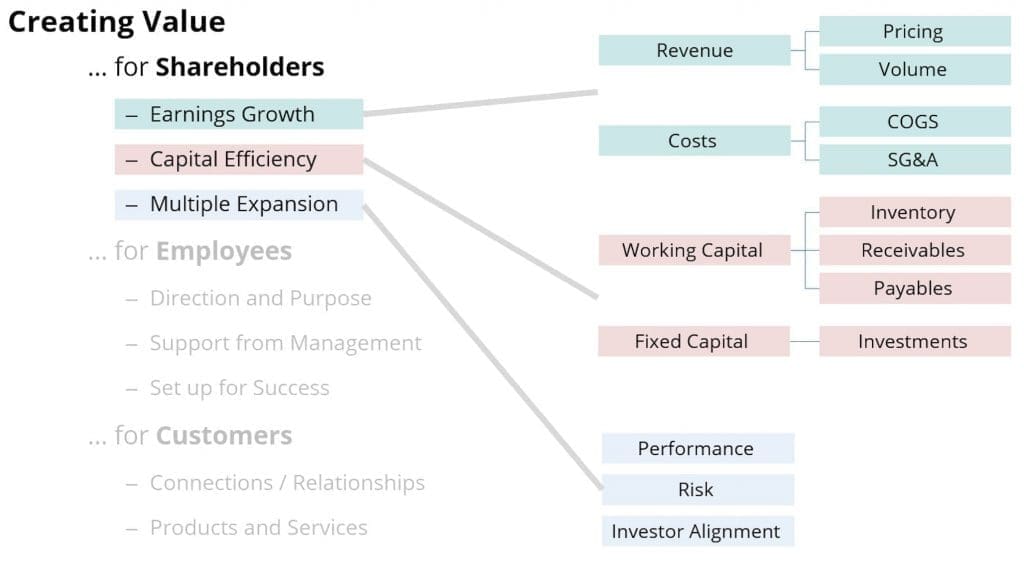
The umbrella term is Total Shareholder Return, and it breaks down into three levers that finance leaders actually use to organize their thinking. Earnings Growth, which is the day-to-day business of taking in more cash than you spend and growing that gap over time. Capital Efficiency, which is what you do with the money the business has already been given to work with. And Multiple Expansion, which is the difference between what the company is technically worth on a spreadsheet and what someone is actually willing to pay for it. Three levers, three different conversations, and AI shows up in all of them – sometimes in ways that surprise the people running the numbers.
The shop floor doesn’t think in this language, and shouldn’t have to. But when an AI initiative needs to get past the operations review and into the capital plan, somebody has to translate. Translating it isn’t dishonest. It’s leadership. So let’s work the translation, lever by lever.
Earnings Growth: where most AI cases land
Earnings Growth is the most familiar lever, which is why most AI business cases live here. It breaks down into Revenue (sell more, charge more) and Cost (make it cheaper, run it leaner), and almost every operations-side AI pitch is going to hit one of those four sub-levers if it’s hitting anything at all.
Revenue gets the more interesting AI stories these days. Volume growth from AI-augmented sales – better lead scoring, smarter outreach prioritization, content that’s actually relevant to what the prospect is dealing with. Price optimization that finally has enough data to be more than a pricing analyst’s gut feel, especially in businesses where a thousand SKUs cross hundreds of customers and the matrix never quite makes sense. Product Intelligence as a revenue story – information and inference baked into the product itself, sold as a feature rather than included as an afterthought, where a sensor and a model do something the product couldn’t do last year.
Cost is where the volume of AI pitches actually is. Quality automation that drops scrap rate. Predictive maintenance that reduces unplanned downtime and warranty exposure. Document automation that handles back-office paperwork without growing the back-office team. AI-augmented customer service that resolves routine tickets without bouncing them to a human. Each has a defensible cost-reduction case that translates into the shop-floor metrics every operations leader is already tracking. Cost of poor quality drops by half. Customer returns drop by three-quarters. Rework overtime drops by ninety percent. Those numbers, if you can stand behind them, flow straight to the bottom line.
A quick reality check, because Earnings Growth is where the soft-dollar productivity fairy tale lives. “If AI makes my service team thirty percent more productive, that’s a multimillion-dollar savings.” No, it isn’t, unless you’re actually going to have a smaller service team. Productivity that doesn’t translate into either fewer people doing the same work or the same people doing measurably more work doesn’t show up on the P&L. Finance leaders have heard this pitch every quarter since the ERP era. If you want the productivity claim to land, attach it to a specific number of people not getting hired, a specific volume of work absorbed without new headcount, or a specific reduction in overtime – something a finance team can audit twelve months later.
The strongest Earnings Growth pitches name the metric, specify the current baseline (“$100K per month”), commit to a specific change over a specific window (“a 50% reduction within twelve months of go-live”), and note what could go wrong – the operator adoption risk, the model drift risk, the data quality dependency. That last bit is what separates an AI initiative from an AI wish, and finance leaders can feel the difference within thirty seconds of you opening the slide.
Capital Efficiency: the lever AI was made for
Capital Efficiency is the quieter cousin of Earnings Growth, and it deserves more attention than it gets in most AI conversations. The question being answered is simple: how well is the business using the money it has already been given? Cash tied up in inventory isn’t earning anything. Receivables that sit too long are working capital you don’t have. Payables that go out too fast are giving your suppliers a free loan. Move any of these the right direction and you free up cash without raising a dollar of new capital, which is exactly the kind of thing boards notice.
Working capital breaks into two pieces. Inventory – raw materials, work in process, finished goods, plus the warranty reserve that sits on the balance sheet as a hedge against future returns. And receivables/payables – how fast you collect from your customers versus how fast you pay your vendors. Both have been worked over for decades by lean practitioners and demand planners, and both still have meaningful room left to improve in most mid-market businesses.
Here’s why AI shows up well in this conversation. Demand forecasting is the canonical use case, and it’s actually one of the few areas where the ML story is unambiguously better than the spreadsheet story. Better forecasts mean leaner inventory targets, which means less cash sitting in the warehouse. A 15% reduction in WIP inventory at a $50M manufacturer is around $375K of freed-up cash – permanent, not one-time, because the leaner level stays leaner. Quality improvements that lower the warranty reserve do similar work on the liability side; a 10% reduction in expected warranty claims on a $2M reserve is $200K that moves off the books. And AI-augmented collections – predicting which customers are about to slow-pay, prioritizing outreach, flagging risk patterns earlier – shaves days off the DSO calculation in ways that compound across the year.
The reason Capital Efficiency is the lever AI was made for, in a way that previous waves of technology weren’t, is that all of these moves depend on accurate prediction at scale. ERP gave you the data. The Internet gave you the visibility. IoT gave you the signal. AI is the first wave that can actually turn the signal into a forecast you’d stake working capital on. The leaders running it well are quietly pulling away on this lever while everyone else is still showing each other chatbot demos.
A quick honest note. There’s a lot more to Capital Efficiency than working capital – tax structures, capital allocation, return on invested capital, the deeper financial engineering that good CFOs do. I’m sticking to what I know, which is the working-capital piece, partly because that’s where most AI initiatives actually land and partly because the heavier finance work is, frankly, somebody else’s specialty.
Multiple Expansion: the lever the 2020 version skipped
Multiple Expansion is the gap between what the company is technically worth, based on the actual numbers, and what the market is willing to pay for it. It’s the part of valuation that lives in sentiment, story, and expectations about the future. When I wrote about this lever a few years ago, I called it squishy and skipped past it. The mechanisms for moving the multiple were diffuse, the AI conversation wasn’t yet a board-level topic, and the honest answer was that most of the available levers lived elsewhere. That answer no longer holds.
Multiple Expansion comes from three drivers, and AI changes the texture of all three. Performance – does the company hit its projections, quarter after quarter, with the kind of consistency that earns the benefit of the doubt? Risk – is the business protected against disruptions that could materially hurt it? And Investor Alignment – how does the market actually feel about the company, its leadership, and its position relative to its peers?
Performance is the cleanest connection. AI-augmented planning and forecasting make hitting projections genuinely more achievable, because the leadership team has better visibility into the variables that drive the business. Predictive operations – the demand forecast, the supply forecast, the working capital forecast – cut down the surprise factor that historically blew up earnings calls. Predictive maintenance does the same on the operations side. None of this is glamorous, but consistent execution is what earns a multiple over time, and AI capability is now one of the credible inputs.
Risk is where the conversation has gotten richer, and uglier, since 2020. Cybersecurity used to be the canonical risk-management justification – a non-revenue project that protected the business from a category of disaster that’s increasingly likely. That argument still holds, but the threat surface has expanded. Data poisoning, where attackers corrupt the training data behind your models. Prompt injection, where customer-facing AI systems get manipulated into doing things they shouldn’t. Model supply chain risk, where the open-source components you’re building on turn out to have provenance problems. These aren’t theoretical, and the boards that ask the right questions about them are doing real work on the multiple.
The risk story has also flipped on one important dimension. The dominant risk used to be doing the wrong thing – bad investment, failed implementation, value destruction. The newer risk, the one boards are starting to price in, is the risk of not doing things while competitors do them well. Norton Rose Fulbright tracked a sharp rise in AI-related shareholder proposals starting in 2024, and the proposals aren’t only about constraint and governance – some are pushing for more aggressive AI adoption, with shareholders explicitly arguing that boards aren’t moving fast enough. That’s a flavor of pressure that didn’t exist five years ago.
Investor Alignment is the third driver, and it’s the one most leaders are least prepared for. The shorthand is what’s your AI story, and your CFO has almost certainly been asked some version of this question already. BCG’s “Build for the Future 2025” research showed the leader-laggard gap widening, with the top 5% of companies seeing 5x the revenue increases and 3x the cost reductions everyone else is getting from AI, while the bottom 60% report minimal returns and don’t yet have the capabilities to scale. McKinsey’s research lands in roughly the same territory – 2x to 6x TSR deltas depending on industry. These numbers are in the analyst notes and the M&A pitch books, and your investors have seen them.
Joel Trammell, who has spent years thinking about how boards actually work, makes the point sharply in his piece on AI and the boardroom. The market is starting to price AI capability as a leading indicator of future earnings, not just an operational improvement. The companies that look like they’re going to compound an advantage are getting credit for it before the advantage shows up in the financials. The cost of moving slowly isn’t just the projects you didn’t do. It’s the multiple compression you wear while you catch up.
So Multiple Expansion is no longer squishy. It’s a fast-moving variable that responds to how credibly the leadership team is talking about AI, how visibly they’re investing in it, and how well they’re managing the new risk categories that come with it.
The trap: cutting your way to a better multiple
Here’s where this article has to slow down and tell the truth, because the Multiple Expansion argument has a failure mode that’s already showing up in the data.
The cynical version goes like this. AI capability moves the multiple. Headcount reductions are the fastest, most visible way to demonstrate AI capability. Therefore, cut headcount in the name of AI, take the productivity win, and ride the multiple expansion. It’s a clean argument and easy to model on a spreadsheet, which is why a lot of boards have run some version of it over the last eighteen months. The problem is that it doesn’t work.
Trammell cites a Gartner finding from 2026 that’s worth sitting with: roughly 80% of large enterprises have made staff reductions tied to AI initiatives, and the correlation between those reductions and improved ROI is essentially zero. The savings show up in next quarter’s P&L, sure. But the operational capability to execute the AI vision walks out the door with the people who were going to make it work, and the multiple gap that opened in the analyst notes doesn’t close, because the analysts can read past a one-time savings event to the question of whether the underlying business is actually getting better at anything.
Bain has a counterpart number from the other direction. Their research on companies that lead AI adoption with their people – serious investment in skills, careful work redesign, engagement-first rollouts – shows about 2.3x the TSR delivered by companies that don’t. Same time horizon, same kind of AI investment, dramatically different outcome. The people-first version of AI adoption produces the shareholder return that the cost-first version only promises.
This isn’t an anti-shareholder argument. It’s a pro-shareholder argument. The boards making the easy cuts are the boards getting the worse returns. The market is paying a premium for the AI-and-engagement story and discounting the AI-as-layoff-justification story, and the gap shows up in the multiple within a couple of years.
AI opportunities, by Building Block
Pulling this back to the practitioner level, here’s how AI initiatives in each of the Five Building Blocks typically connect to the TSR levers. Strong initiatives usually hit two, sometimes three, and the connections are worth being explicit about.
- Operational Excellence: AI-augmented quality inspection, predictive maintenance, workflow automation. Primary lever Earnings Growth (cost reduction on COGS and overhead), secondary Capital Efficiency (lower warranty reserve, reduced WIP) and Multiple Expansion (performance consistency).
- Customer Connection: AI-augmented service tools, sentiment analysis at scale, predictive account health monitoring. Primary lever Earnings Growth (retention, ARR stability), secondary Multiple Expansion (the customer relationship story analysts increasingly ask about).
- Product Intelligence: AI-enriched products and services, embedded inference, predictive features. Primary lever Earnings Growth (revenue from differentiated offerings), strong secondary Multiple Expansion (competitive positioning and the AI-story narrative).
- Data Mastery: ML-driven forecasting, planning, and pricing optimization. Primary lever Capital Efficiency (inventory, working capital), secondary Earnings Growth (price optimization) and Multiple Expansion (execution consistency).
- Team Dynamics: AI tools that change the work, not just speed it up – and the engagement that comes from getting that change right. Primary lever Multiple Expansion via the Bain 2.3x TSR finding, secondary Earnings Growth through retention and productivity.
Cybersecurity deserves a separate note. The 2026 version isn’t the 2020 version. Data poisoning, prompt injection in customer-facing systems, and model supply chain risk are real categories that boards and auditors are asking about. Investments in protecting the AI itself connect to Multiple Expansion through the Risk driver, and they’re increasingly table stakes for serious AI conversations with investors. The risk story isn’t a separate Building Block; it cuts across all five.
What to do before the next finance review
Two things, before the next AI initiative hits the finance committee.
First, map your current AI initiatives to specific TSR levers in plain language. Not “AI helps the business everywhere,” which finance leaders rightly hear as “I don’t have a value story.” For each initiative, name the lever (Earnings Growth, Capital Efficiency, Multiple Expansion), name the metric ($/month, $/year, basis points), and name what could go wrong. If you can’t fill in those three blanks, you don’t have a project – you have a slide.
Second, get ahead of the Multiple Expansion question, because your CFO is already getting it from analysts and your board chair is already getting it from peers. The AI story your company tells in earnings calls and investor letters is now a real input into how the market values you. If you don’t draft that story, finance will draft it for you, and they won’t draft it the way you would.
Want to think through your own AI value conversations? Sign up for the JazzAI mailing list – practical frameworks for mid-market leaders making technology decisions without a seasoned CIO in their corner.
Related Articles
- Rewired for value: Digital and AI transformations that work (McKinsey) – Banking-sector longitudinal data showing digital leaders deliver 8.1% annual TSR versus 4.9% for laggards. The hard evidence behind the TSR-and-AI argument.
- Is Generative AI Creating Shareholder Value in Publicly Listed Companies? (MIT Sloan, with Bain) – Direct treatment of whether GenAI investments are actually moving the needle on shareholder value for public companies.
- Where’s the Value in AI? (BCG, October 2024) – The earlier BCG report that lays groundwork for the 2025 leader-laggard gap research, with industry-by-industry maturity rankings.
Recommended Books
- The Outsiders: Eight Unconventional CEOs and Their Radically Rational Blueprint for Success by William N. Thorndike – The classic study of CEOs who delivered extraordinary TSR through unusual capital allocation. The exact pattern this article argues AI initiatives need to fit into.
- Valuation: Measuring and Managing the Value of Companies (8th edition) by Tim Koller, Marc Goedhart, and David Wessels (McKinsey & Company) – The canonical practitioner’s text on TSR, value creation, and the mechanics of multiple expansion. Heavier than this article, but the right next read for leaders who want the full finance treatment.
- Don’t Think So Much by Jim MacLennan – The practical mindset for tech-aware leadership, including the kind of cross-functional translation work this article spends most of its time on.
2 June, 2026





Comments (0)